

On -Grid Solar Power System
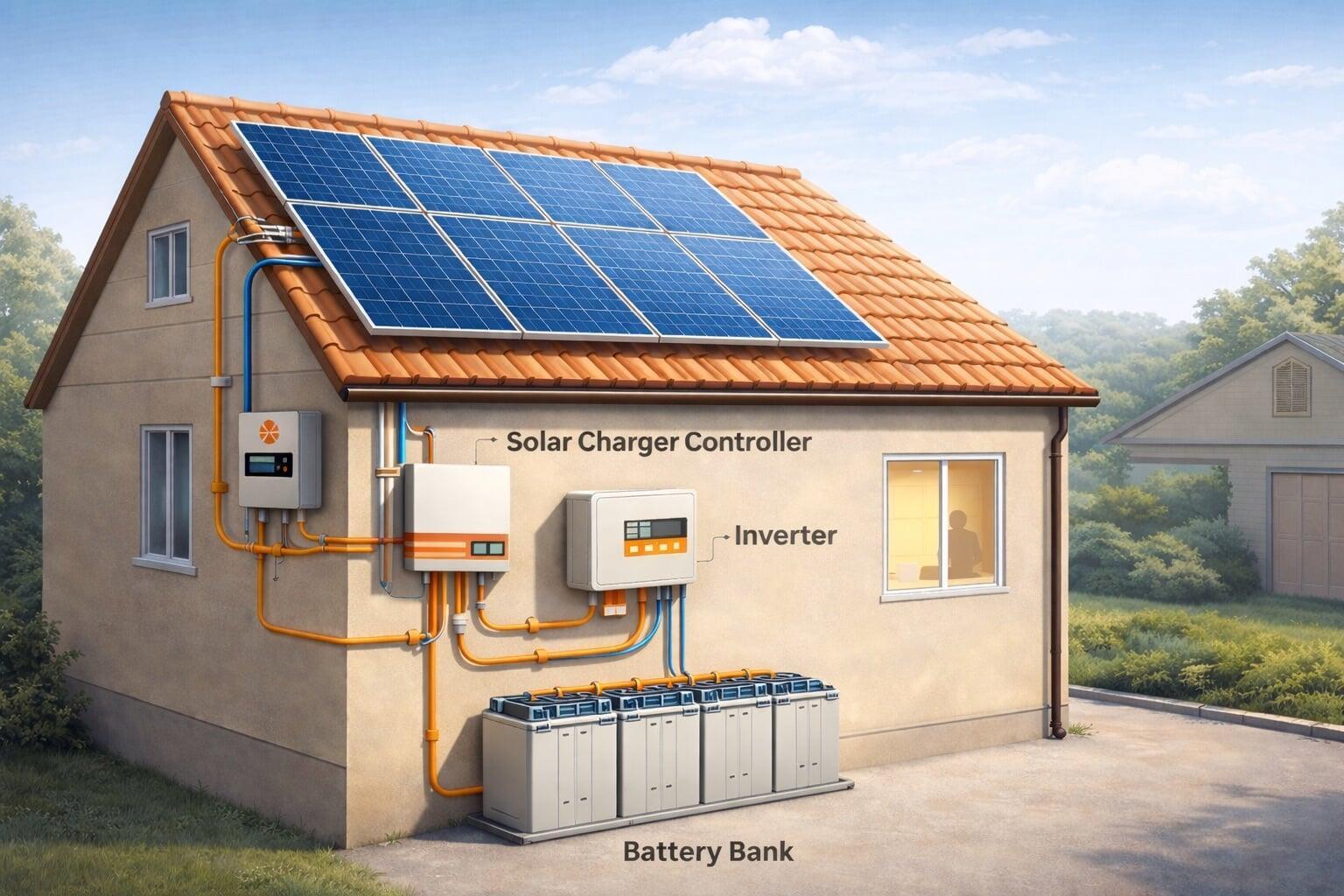
Off-Grid Solar Power System

Hybrid Solar Power System
Solar Water Heater

Solar Pumping System

Solar Street Light
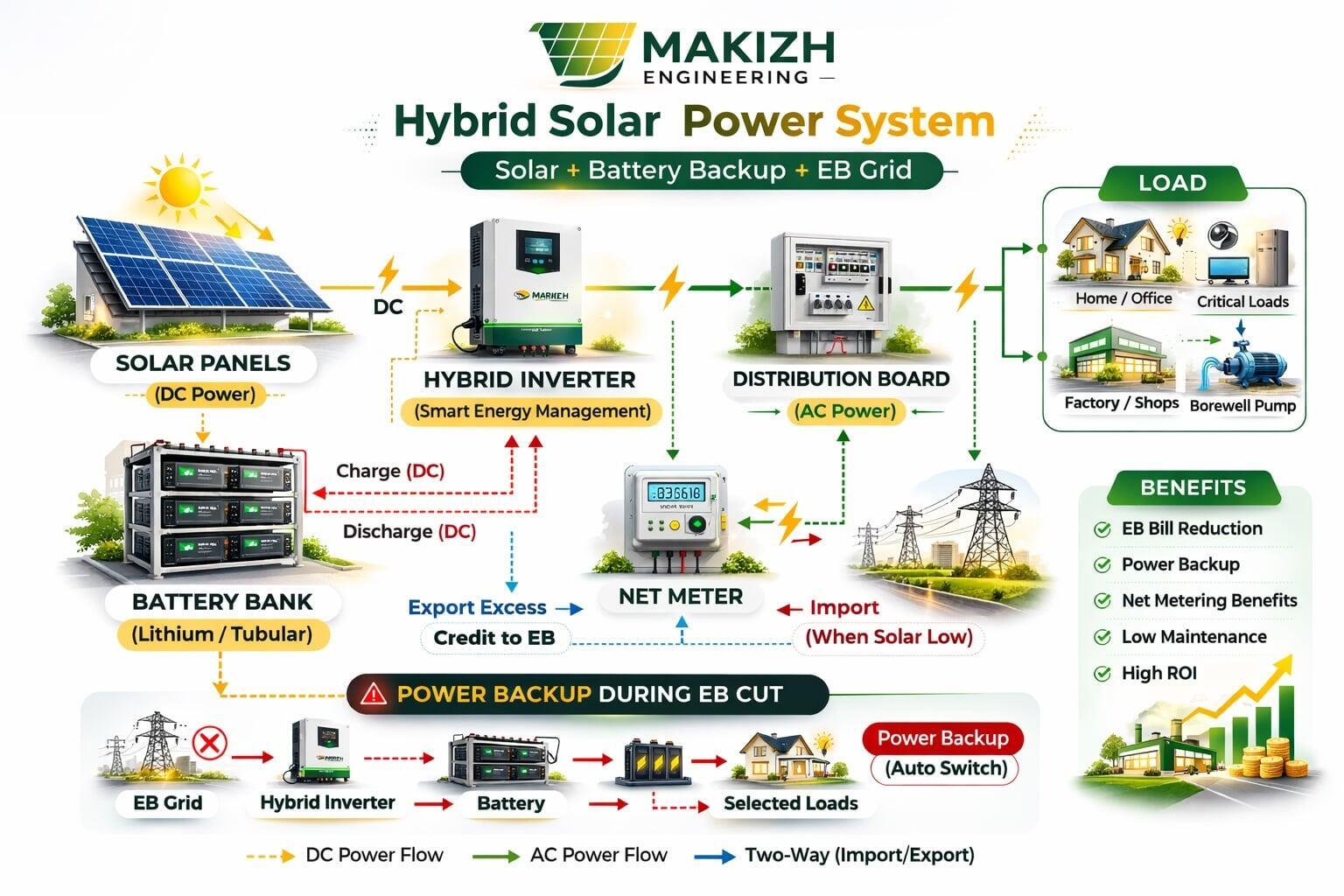
Hybrid Solar Power System
Hybrid Solar Power System
Smart Power Backup + Maximum Savings
Smart Power Backup + Maximum Savings
A Hybrid Solar System combines:
Solar Panels
Hybrid Inverter
Battery Backup
EB Grid Connection
It gives you the best of both worlds:
- EB bill reduction
- Backup during power cuts
- Smart energy management
How Hybrid Solar Works
How Hybrid Solar Works
Solar Panels → Hybrid Inverter →
→ Runs Load
→ Charges Battery
→ Exports excess to EB grid
During power cut:
Battery automatically powers selected loads.
No manual switching.
Who Should Choose Hybrid Solar?
Who Should Choose Hybrid Solar?
Ideal for:
Areas with frequent power cuts
Homes with inverter backup already
Small industries needing continuous power
Hospitals, clinics, IT offices
Shops with refrigeration
Borewell Pumpsets
If EB is unstable → Hybrid is safest choice.
Financial Outcome
Financial Outcome
5 kW Hybrid System – Residential
Average EB bill: ₹6,000/month
Solar offset: ₹4,500–₹5,500/month
Backup for: 3–5 hours
Payback: 4–6 years
Higher cost than on-grid
But gives energy security.
Commercial Hybrid Outcome
Commercial Hybrid Outcome
For small factories:
Prevents production downtime
Avoids diesel generator cost
Reduces EB demand charges
Supports sensitive equipment
Savings + reliability.
Hybrid System Components
Hybrid System Components
- High-efficiency solar panels
- Hybrid inverter (with smart switching)
- Lithium / Tubular battery bank
- Net meter integration
- AC & DC protection panels
- Surge & earthing system
All designed based on load study.
Government Subsidy
Hybrid systems with grid connection may qualify for residential subsidy (subject to latest policy updates).
Typical subsidy under PM Surya Ghar Scheme:
Up to ₹30,000 per kW (for initial capacity)
Direct credit to consumer
Makizh Engineering assists with:
Portal registration
EB coordination
Net meter process
Technical documentation
Bank Loan Possibility
Bank Loan Possibility
Hybrid systems are eligible for:
SBI Solar Loans
Nationalized bank green loans
NBFC financing
EMI often comparable to:
EB bill + inverter maintenance cost.
After loan completion → long-term savings.
Hybrid Solar - Pros & Cons
Hybrid Solar - Pros & Cons
Advantages
Power backup during outage
Lower EB bill
Diesel generator reduction
Smart load prioritization
Expandable system
Limitations
Higher initial cost than on-grid
Battery replacement after lifespan
Slightly longer ROI
If zero power cut → On-grid may be enough.
If frequent outages → Hybrid is better investment.
Hybrid Solar - Pros & Cons
Advantages
Power backup during outage
Lower EB bill
Diesel generator reduction
Smart load prioritization
Expandable system
Limitations
Higher initial cost than on-grid
Battery replacement after lifespan
Slightly longer ROI
If zero power cut → On-grid may be enough.
If frequent outages → Hybrid is better investment.
Check if Hybrid is Right For You
Check if Hybrid is Right For You
Upload your EB bill & answer 4 questions:
How many hours backup needed?
What critical loads must run?
Monthly EB bill?
Future expansion plans?
Get:
Recommended kW size
Battery size
ROI estimate
EMI comparison
Why choose Solar?
Electricity consumption has increased steadily over the last 20 years.
Rising usage + rising tariffs = long-term cost pressure.
Solar locks your energy cost today.
Residential (Average Urban Household)
2005 → ~90 units/month
2010 → ~110 units/month
2015 → ~135 units/month
2020 → ~165 units/month
2025 → ~200 units/month
Trend assumption
(Average residential tariff):
- 2005 → ₹3.0/unit
- 2010 → ₹3.8/unit
- 2015 → ₹4.8/unit
- 2020 → ₹5.5/unit
- 2025 → ₹6.5/unit
Commercial (Small Commercial Establishment)
2005 → ~400 units/month
2010 → ~520 units/month
2015 → ~650 units/month
2020 → ~820 units/month
2025 → ~1000 units/month
Trend assumption
(Average commercial tariff):
- 2005 → ₹5.5/unit
- 2010 → ₹6.8/unit
- 2015 → ₹7.8/unit
- 2020 → ₹8.8/unit
- 2025 → ₹9.8/unit
Decision Guide
Feature | On-Grid | Hybrid | Off-Grid |
|---|---|---|---|
EB Bill Reduction | ✔ | ✔ | ❌ |
Backup During Power Cut | ❌ | ✔ | ✔ |
Battery Required | ❌ | ✔ | ✔ |
Investment | Low | Medium | High |
Ideal For | Stable EB | Power Cut Areas | No EB |


